
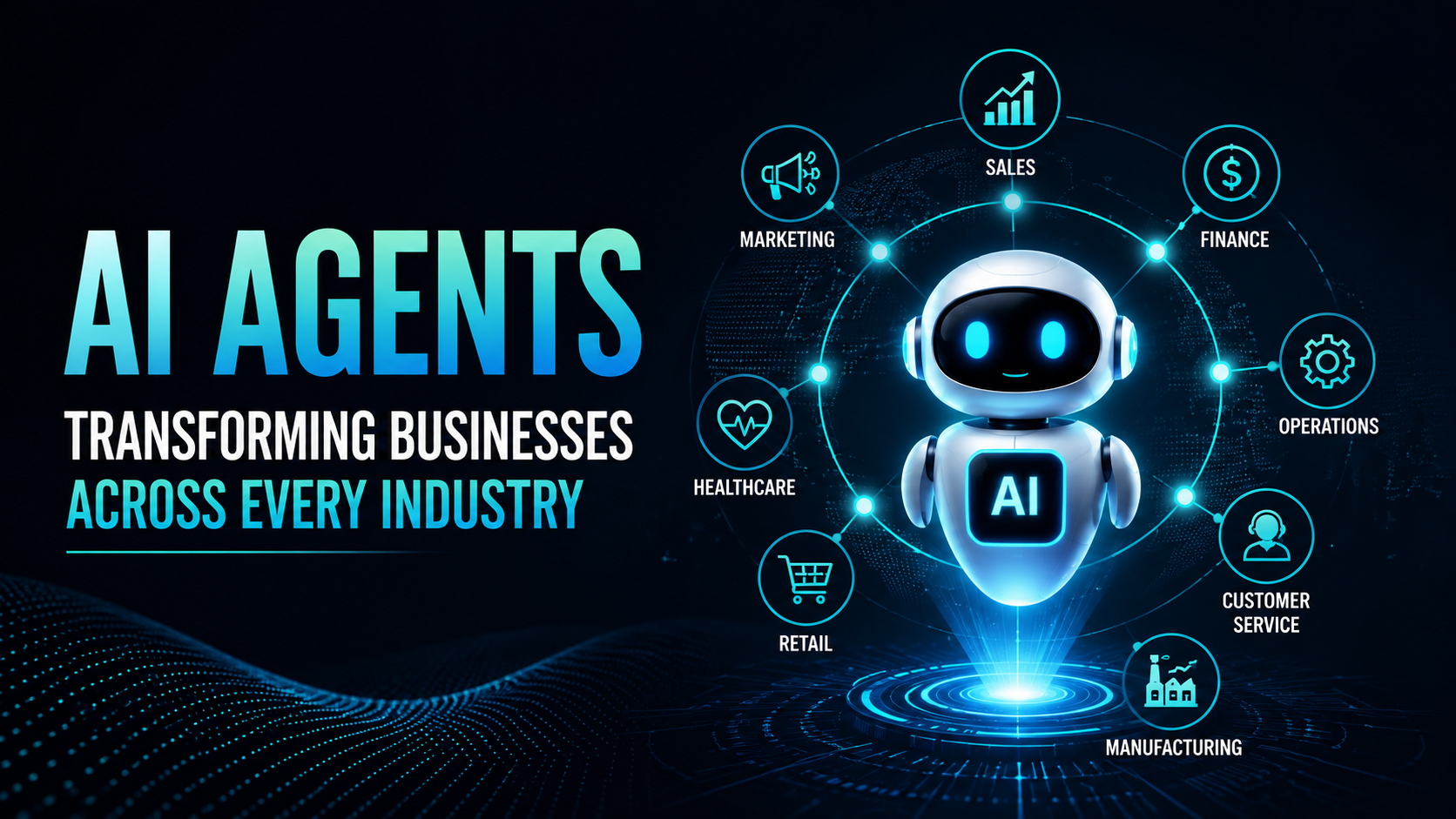
Why Are Businesses Adopting AI Agents?
Businesses are under constant pressure to accomplish more with limited resources.
Leadership teams want to:
- Reduce operational costs
- Improve employee productivity
- Respond to customers faster
- Increase sales efficiency
- Reduce repetitive work
- Improve decision-making
- Scale operations
- Deliver better customer experiences
AI agents can support several of these objectives simultaneously.
The biggest change is the movement from AI assistance to AI execution.
Traditional AI
An employee asks AI to write an email.
Agentic AI
An AI agent identifies the right customer, researches relevant information, prepares the email, updates the CRM, and triggers the next step — with human approval where necessary.
That is where the business value becomes much more interesting.
AI Agents for Business: Where Can They Create Value?
The strongest AI Agents for Business opportunities usually appear in workflows involving repetitive decisions, large volumes of information, multiple systems, or frequent manual handoffs.
1. Sales
Sales teams spend considerable time on activities that happen before and after the actual sales conversation.
AI agents can help with:
- Lead qualification
- Prospect research
- Lead enrichment
- CRM updates
- Personalized outreach
- Follow-up reminders
- Meeting preparation
- Sales-call summaries
- Proposal preparation
- Opportunity prioritization
Instead of replacing sales professionals, AI can remove administrative work and allow them to focus on: Relationships + Negotiation + Strategy + Closing
2. Marketing
Modern marketing involves research, content, analytics, customer segmentation, campaigns, and constant optimization.
AI agents can support:
- Market research
- Competitor monitoring
- Content research
- SEO workflows
- Campaign analysis
- Customer segmentation
- Lead nurturing
- Social media workflows
- Performance reporting
For example, an AI marketing agent could monitor campaign performance, identify underperforming channels, analyze customer behavior, and prepare recommendations for the marketing team.
That is considerably more powerful than simply asking AI to write another social media post.
3. Customer Service
Customer support is one of the most practical areas for AI agents.
Agents can:
- Understand customer questions
- Search knowledge bases
- Retrieve account information
- Resolve common requests
- Create support tickets
- Update customer records
- Categorize issues
- Escalate complex cases
- Follow up automatically
The best model is often human + AI, rather than AI alone. AI handles high-volume and predictable interactions. Humans handle complex, sensitive, or high-value situations.
4. Finance and Accounting
Finance departments process large amounts of structured and unstructured information.
AI agents can assist with:
- Invoice processing
- Expense categorization
- Payment reminders
- Financial reporting
- Document extraction
- Reconciliation workflows
- Purchase-order checks
- Accounts receivable follow-ups
- Financial data analysis
For example, an AI agent could identify overdue invoices, analyze the customer's history, prepare a follow-up message, and send it for approval.
The finance team spends less time on repetitive administration and more time on financial control and strategic decisions.
5. Human Resources
HR teams manage large volumes of employee and candidate information.
AI agents can support:
- Resume screening
- Candidate matching
- Interview scheduling
- Employee onboarding
- HR FAQs
- Policy information retrieval
- Training recommendations
- Employee feedback analysis
- Internal knowledge management
However, HR requires careful governance. AI should support hiring and employee decisions — not become an uncontrolled decision-maker.
AI Agents Across Industries
The impact of AI agents goes far beyond individual departments.
Healthcare
Potential applications include:
- Appointment coordination
- Patient communication
- Administrative documentation
- Referral coordination
- Insurance workflow support
- Staff scheduling
- Knowledge retrieval
Banking and Financial Services
Financial organizations can use AI agents for:
- Customer service
- Document processing
- Compliance workflows
- Customer onboarding
- Fraud investigation support
- Loan documentation
- Financial research
Manufacturing
Manufacturing can combine AI agents with operational data to support:
- Predictive maintenance
- Inventory management
- Supplier communication
- Quality-control reporting
- Procurement
- Production scheduling
- Operational monitoring
Imagine an agent detecting an operational anomaly, checking relevant maintenance information, creating a service request, and notifying the responsible team.
Retail and E-commerce
AI agents can support the entire customer journey. Applications include:
- Product recommendations
- Customer support
- Order tracking
- Inventory monitoring
- Personalized marketing
- Cart recovery
- Customer review analysis
- Demand analysis
Logistics and Supply Chain
AI agents can monitor:
- Inventory
- Shipment status
- Supplier communication
- Delivery exceptions
- Purchase orders
- Demand signals
- Logistics documentation
Real Estate
Real estate companies can use AI agents for:
- Lead qualification
- Property matching
- Customer communication
- Appointment scheduling
- Listing analysis
- Market research
- Follow-ups
- Document management
Education
AI agents can support:
- Student assistance
- Course administration
- Scheduling
- Personalized learning
- Feedback analysis
- Research
- Administrative communication
AI Business Automation: Beyond Simple Automation
AI Business Automation combines traditional workflow automation with AI-based reasoning.
Consider a typical sales workflow.
The human remains involved where judgment matters. AI removes unnecessary manual work around that person.
This is the real opportunity behind intelligent business automation. The goal is not to replace traditional automation, but to combine dependable rule-based automation for predictable steps with AI agents for the variable, knowledge-heavy ones. Our guide to choosing between AI agents and AI automation shows where each one fits.
Enterprise AI Solutions: From Tools to Infrastructure
There is a major difference between employees using AI tools individually and implementing Enterprise AI Solutions.
Individual AI usage
An employee opens an AI application and asks it to perform a task.
Enterprise AI
AI becomes connected to CRM, ERP, project-management systems, customer-support platforms, internal knowledge bases, databases, APIs, workflow automation platforms, and security systems.
This creates a connected AI layer across the organization.
For enterprise leaders, the challenge is therefore not simply choosing the latest AI model. It is building an environment where AI can operate:
Securely + Reliably + Measurably + Within Business Rules
How to Identify AI Opportunities in Your Business
Before investing in an AI platform, look at your business processes. Ask these questions:
1. Where are employees losing the most time?
Look for repetitive tasks such as:
- Data entry
- Email processing
- Reporting
- Research
- Scheduling
- Document processing
2. Where are employees repeatedly making decisions?
Look for workflows involving:
- Classification
- Comparison
- Prioritization
- Summarization
- Recommendations
3. Where are multiple systems involved?
These are often strong automation opportunities. For example:
An AI agent can potentially coordinate parts of this workflow.
4. What has measurable ROI?
Consider: Time saved × Frequency × Cost
Also evaluate:
- Revenue impact
- Customer satisfaction
- Response time
- Error reduction
- Employee capacity
What Makes an AI Agent Successful?
Technology alone does not guarantee success. A successful AI agent needs five things.
- A clear objective — the agent needs a specific business purpose.
- Reliable data — poor data produces unreliable results.
- Tool access — the agent needs access to the systems required to complete its task.
- Guardrails — define what the agent can and cannot do.
- Measurement — track actual business outcomes.
Useful KPIs include:
- Hours saved
- Cost reduction
- Response time
- Conversion rate
- Resolution rate
- Error rate
- Customer satisfaction
The Human + AI Model
The most effective future is unlikely to be humans vs AI. It is humans + AI agents.
Humans remain strong at
Leadership, strategy, negotiation, empathy, creativity, relationship building, complex judgment.
AI agents are strong at
Monitoring, processing, searching, classifying, summarizing, coordinating, repetitive execution.
The competitive advantage comes from designing the right division of work.
Emerging AI Agent Trends in 2026
The AI landscape is moving rapidly from standalone AI assistants toward more connected, agentic systems.
Multi-Agent Systems
Instead of one AI agent performing every task, businesses can create specialized agents. For example:
Each agent performs a specific function.
AI Agents Connected to Business Systems
The value of AI increasingly depends on what it can do, not simply what it can generate. Connecting agents with CRM, ERP, databases, communication tools, and workflow systems can create significantly more useful business processes.
Stronger AI Governance
As AI agents gain the ability to take actions, companies need controls around:
- Permissions
- Data access
- Security
- Audit trails
- Human approvals
- Monitoring
Specialized AI Models
Businesses do not always need the largest model available. Factors such as cost, accuracy, speed, privacy, reliability, and task-specific performance are increasingly important when selecting AI infrastructure.
Common AI Agent Mistakes Businesses Should Avoid
Starting with the technology. Do not begin with "Which AI tool should we buy?" Begin with "Which business problem should we solve?"
Automating a broken process. AI can make a poor process faster — but it does not automatically make it better. Improve the workflow first. Automate second.
Giving agents unlimited access. Agents should have clearly defined permissions.
Ignoring data quality. AI cannot consistently compensate for poor business data.
Measuring AI activity instead of business outcomes. The number of AI prompts or tasks completed is not the real KPI. Measure: time saved + cost reduced + revenue created + experience improved.
When Do You Need AI Consulting Services?
AI Consulting Services become particularly valuable when leadership teams need help determining:
- Where AI will create the highest ROI
- Which workflows should be automated
- Which AI tools should be selected
- Whether to build or buy
- How AI should integrate with existing systems
- What security controls are necessary
- Where human approval should remain
- How AI ROI should be measured
Effective AI consulting should begin with business objectives and workflows, not a list of trendy AI tools.
That is how organizations avoid expensive AI experiments that never reach production.
A Practical AI Agent Roadmap
| Stage | Focus | Key Question |
|---|---|---|
| 1 | Discover | Where are we losing time? |
| 2 | Prioritize | Which workflow has the highest ROI? |
| 3 | Design | What should AI do vs humans? |
| 4 | Pilot | Can we prove the value? |
| 5 | Measure | Did the business improve? |
| 6 | Govern | Is the system safe and controlled? |
| 7 | Scale | Where else can we apply it? |
This approach allows businesses to move from AI experimentation to measurable implementation.
What Should Your AI Agent Actually Do?
The strongest companies will not necessarily be those with the largest number of AI tools. They will be the companies that redesign their workflows around intelligent systems.
Imagine a business where:
- Leads are researched automatically.
- Customer questions are classified instantly.
- Reports prepare themselves.
- Finance teams receive exception alerts.
- Employees can instantly access company knowledge.
- Marketing systems continuously analyze campaign performance.
- Managers receive AI-generated operational insights.
- Repetitive workflows run with minimal manual intervention.
That is the larger opportunity. AI agents are not simply about doing individual tasks faster. They are about creating organizations that can:
faster than traditional operating models.
Frequently Asked Questions
Are AI agents suitable for enterprises?
Yes. Enterprises can deploy AI agents across sales, customer service, finance, HR, IT, operations, supply chain, and knowledge management. Enterprise deployments require appropriate security, governance, access controls, and monitoring.
How much does AI agent implementation cost?
There is no single price. Cost depends on the workflow, complexity, integrations, AI models, data requirements, security, and scale. A focused pilot is often the best starting point.
How should a business choose an AI agent?
Start with the business problem. Identify repetitive or knowledge-intensive workflows, estimate ROI, evaluate data and integration requirements, define governance requirements, and then select the technology.
Should businesses build or buy AI agents?
It depends on technical capabilities, workflow complexity, security requirements, budget, and scalability needs. Many businesses can begin with existing platforms and customize their architecture as requirements grow.
How long does it take to implement an AI agent?
It depends on the workflow, the number of systems involved, data readiness, and how much human approval is required. A focused pilot on a single workflow can be scoped and tested far sooner than a company-wide rollout, which is why most implementations start with one workflow and expand once results are measured.
How do we measure the ROI of an AI agent?
Set a baseline before the pilot, then track the outcomes the workflow is meant to improve, such as hours saved, cost reduction, response time, conversion rate, resolution rate, error rate, and customer satisfaction. Compare results against the baseline to decide whether to scale.
What security and governance controls do AI agents need?
Define exactly which systems and data each agent can access and what it is allowed to change. Keep human approval in place for high-risk actions, and monitor performance, accuracy, and cost so the agent stays within business rules.
When should a business bring in an AI consulting partner?
Consulting is most valuable when leadership needs help deciding where AI will deliver the highest ROI, which workflows to automate first, whether to build or buy, how to integrate with existing systems, and what security controls and approval points are required.
Final Takeaway for Business Leaders
AI agents are changing the role of AI in business.
The conversation is moving from:
"Can AI help my employees?"
to:
"Can AI operate part of my business?"
That is a much bigger opportunity.
For founders and directors, AI adoption should not be about collecting more AI tools. It should be about identifying high-value workflows where AI can improve revenue, productivity, customer experience, speed, or operational efficiency.
Start with one problem. Build one workflow. Measure the result. Then scale.
Because the competitive advantage will not come simply from having access to AI. It will come from knowing where to deploy it — and redesigning the business around it.
7 Practical Tips for Founders & Directors
- Audit before automating — Understand the workflow before selecting a tool.
- Prioritize ROI — Start with measurable business impact.
- Keep humans involved — Especially for high-risk decisions.
- Connect AI to your systems — Agents become more valuable when they can actually execute workflows.
- Control permissions — Define exactly what each agent can access and change.
- Monitor performance — Track accuracy, cost, reliability, and business results.
- Think beyond prompts — A prompt produces an answer; an agent can potentially complete a workflow.
The Question Every Founder Should Ask
"If I had one digital employee working 40 hours every week to remove repetitive work from my business, what would I ask it to do?"
Your answer may reveal your next major AI opportunity.
AiDreamLab helps businesses explore where AI agents and automation can create practical business value — not simply where AI looks impressive.