
What Is an AI Agent?
An AI agent is a piece of software that you give a goal to, instead of a list of instructions.
With ordinary software, you tell the computer exactly what to do at every step. With an AI agent, you describe the outcome you want, and the agent works out the steps, uses the tools it has been given, and checks whether it got there.
A helpful comparison is the difference between two kinds of requests to a human helper:
Instructions
"Open the calendar. Look at Tuesday. Find a free hour. Write an email. Send it."
A goal
"Set up a meeting with Priya and Sam some time this week."
An AI agent is built to handle the second kind of request.
A chatbot answers. An AI agent acts.
Three ideas separate an agent from a simple question-and-answer tool:
- It works towards a goal, not just a single reply.
- It can use tools, such as a calendar, email, spreadsheet, or search.
- It can take several steps and adjust along the way based on what happens.
A Simple Everyday Example
Imagine you ask an AI agent: "Organize a 30-minute catch-up with Priya and Sam this week."
A basic chatbot could suggest what to write in an invitation. An agent can actually carry the task through:
You gave it one sentence. It handled the steps in between.
The same idea applies to many everyday tasks, such as comparing options and booking travel, sorting an inbox into folders, or turning meeting notes into a task list.
The Building Blocks of an AI Agent
You do not need to be technical to understand what is inside an agent. Most agents combine the same handful of parts.
| Part | What it does | Everyday comparison |
|---|---|---|
| Goal | Tells the agent what outcome you want | The brief you give a new assistant |
| Reasoning model | Understands language, plans, and decides what to do next | The assistant's thinking |
| Tools | Lets the agent take real actions, such as sending an email or searching a database | The assistant's phone, laptop, and app logins |
| Memory and context | Holds the information the agent needs for the current task | The notes on the assistant's desk |
| Guardrails | Sets limits on what the agent may and may not do | The rules of the job |
| Feedback | Lets the agent check its own result and correct course | Reviewing work before handing it in |
The "reasoning model" is usually a large language model (LLM), the same kind of technology behind AI assistants such as ChatGPT. What turns a language model into an agent is the combination of a goal, tools, and a feedback loop around it.
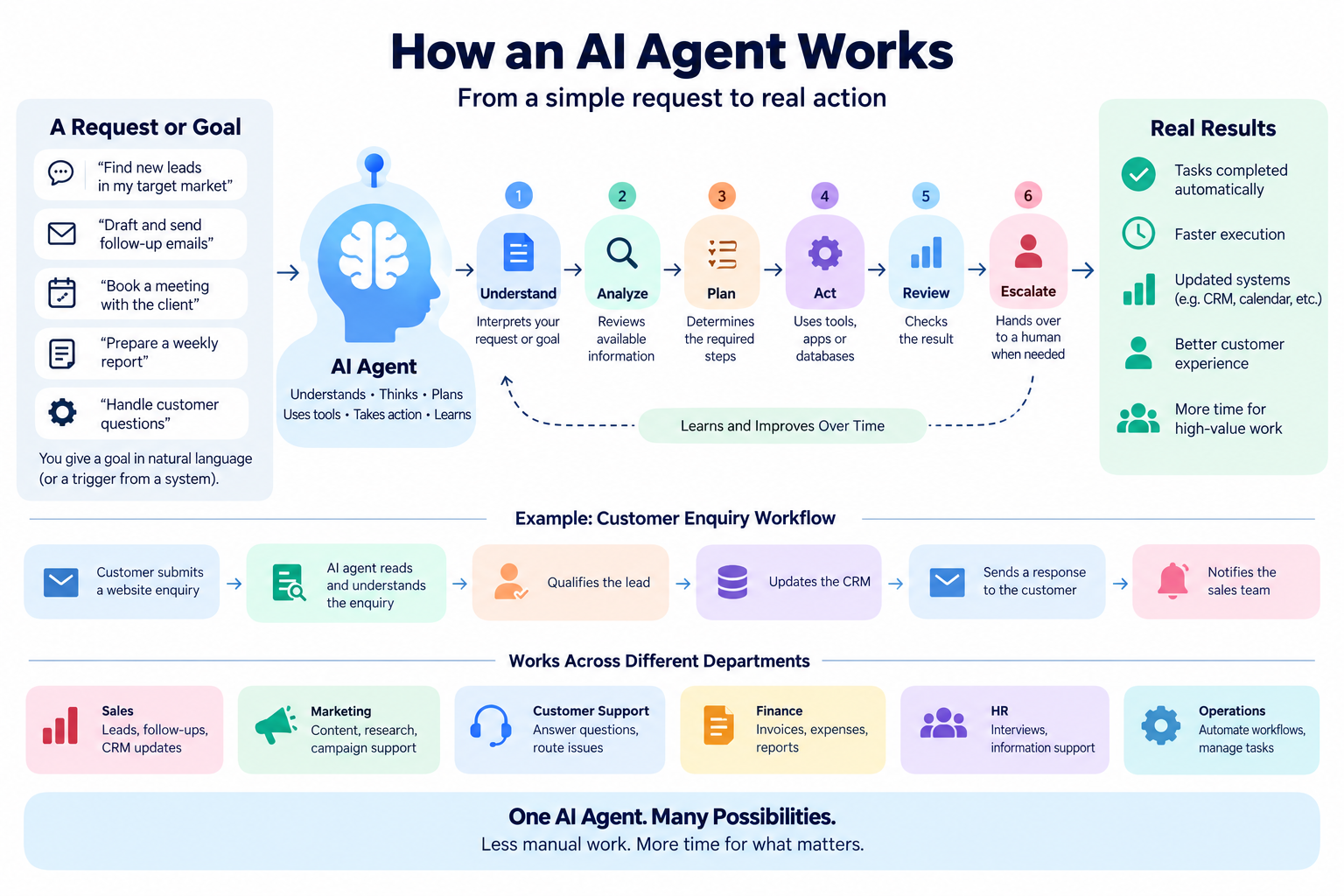
How an AI Agent Works: The Loop
Most AI agents follow a repeating cycle rather than a single straight line.
Each pass through the loop gets the agent a little closer to the goal. If the result of a step is not what it expected, for example a calendar slot is already taken, it can adjust its plan and try another way.
When it is stuck, unsure, or about to do something that needs approval, a well-designed agent stops and asks a person instead of guessing.
AI Agent vs Chatbot vs Assistant vs Automation
These terms are often mixed up. Here is how to tell them apart.
| Type | What you give it | What it does |
|---|---|---|
| Rule-based automation | A fixed trigger and fixed rules | Repeats the same steps every time, exactly as programmed |
| Chatbot | A question | Replies with an answer, often from set responses or a knowledge base |
| AI assistant | A request in natural language | Writes, explains, summarizes, and answers, usually one response at a time |
| AI agent | A goal | Plans the steps, uses tools, checks results, and completes multi-step tasks |
They are not rivals. Many agents include a chatbot-style conversation on the surface and rule-based automation underneath, with an AI model deciding what should happen in between. If you are weighing them up for a business workflow, our comparison of AI agents vs AI automation explains when each one fits.
How Much Independence Does an Agent Have?
"Agent" does not mean "runs wild." How much freedom an agent has is a choice made by the people who set it up. It usually falls into one of three levels:
| Level | How it behaves | Example |
|---|---|---|
| Suggests | Prepares options; a person does the action | Drafts a reply, then you press send |
| Asks first | Does the work but waits for approval before acting | Prepares the invitation and asks "Send this?" |
| Acts within limits | Completes low-risk actions on its own inside set rules | Books a meeting in a free slot, but cannot cancel existing ones |
Beginners are usually best served by starting at the first or second level and moving up only as trust builds.
What AI Agents Are Good At, and Where They Struggle
It helps to have realistic expectations. AI agents are powerful, but they are not magic.
Where they help
Repetitive, multi-step tasks. Searching and sorting large amounts of information. Summarizing and drafting. Coordinating between several apps. Working at any hour without getting tired.
Where they struggle
Vague goals. Missing or unreliable information. Situations that need empathy or ethical judgment. Unusual cases they were not set up for. Confident-sounding mistakes.
Good to know: AI systems can sometimes state something incorrect with complete confidence. This is often called a "hallucination." It is one of the main reasons agents should be given clear limits and their important work should be reviewed by a person.
Key Terms in Plain English
You will see these words often when reading about AI agents.
- Agentic AI: AI that pursues a goal with some independence, rather than only answering one prompt.
- LLM (large language model): the language-understanding technology behind many AI assistants and agents.
- Prompt: the instruction or question you give to an AI system.
- Tool: anything an agent can use to act, such as email, a calendar, a spreadsheet, or a search function.
- API: a standard way for one piece of software to talk to another. It is how agents connect to your apps.
- Workflow: a series of steps that together complete a task.
- Guardrails: the rules and limits that keep an agent within safe boundaries.
- Human-in-the-loop: a setup where a person reviews or approves what the agent does.
- Hallucination: when an AI system produces something that sounds right but is wrong.
How to Start Learning About AI Agents
You do not need to build anything to get started. A practical path for beginners:
- Get comfortable with an AI assistant. Use one for everyday tasks such as summarizing, drafting, and brainstorming, so you learn how AI responds to instructions.
- Notice your repetitive tasks. Which small, multi-step jobs do you repeat every week?
- Describe one task as a goal. Write a clear outcome and the limits you would want, for example "never send anything without my approval."
- Try a simple agent-style tool with approval turned on. Watch each step it takes and learn where it helps and where it needs guidance.
- Review and improve. Adjust your instructions and permissions based on what you see.
If you would like guided, hands-on learning, explore our AI courses and training programs.
Frequently Asked Questions
What is an AI agent in simple terms?
An AI agent is software that you give a goal to, rather than step-by-step instructions. It works out the steps, uses connected tools to carry them out, checks the result, and asks a person for help when it is unsure.
Are AI agents the same as ChatGPT?
No. ChatGPT is primarily a conversational AI assistant that responds to what you type. An AI agent can go further by using applications and tools to complete multi-step tasks. Many agents are built on the same kind of language model that powers assistants like ChatGPT.
What is agentic AI?
Agentic AI describes AI systems that can pursue a goal with some independence, planning steps, using tools, and adjusting based on results, instead of only answering a single prompt.
Do I need to know how to code to use AI agents?
Not necessarily. Many agent tools can be set up with plain-language instructions and no-code connections to your apps. Coding knowledge helps when you want to build custom agents, but it is not required to understand or start using them.
Are AI agents safe to use?
They can be, when used with clear limits. Agents can make mistakes, so it is good practice to restrict what they can access, require human approval for important actions, and review their work, especially when you are starting out.
Can an AI agent make mistakes?
Yes. AI agents can misunderstand a goal, work from incomplete information, or produce confident but incorrect output. Clear instructions, reliable data, and human review reduce the risk.
Where to Go Next
You now have the foundation: an AI agent takes a goal, plans steps, uses tools, checks its work, and keeps a person involved where it matters.
The goal of learning about agents is not to replace human thinking. It is to give people more time for the work that needs judgment, creativity, and care.
Once these basics feel comfortable, the next question is how organizations put agents to work. Our in-depth article on how AI agents are transforming businesses across every industry covers use cases, enterprise adoption, and how to plan a first implementation.
At AI Dream Lab, we help people and businesses understand and apply practical AI, from first concepts to real workflows.